
What Is a Submittal, and Why the Review Process Matters
A submittal is documentation, a shop drawing, a product data sheet, a sample, a mockup, that a contractor sends up the chain so the design team can confirm the right materials and methods are heading to the job site. The review process is the check that stands between what was specified and what actually gets built.
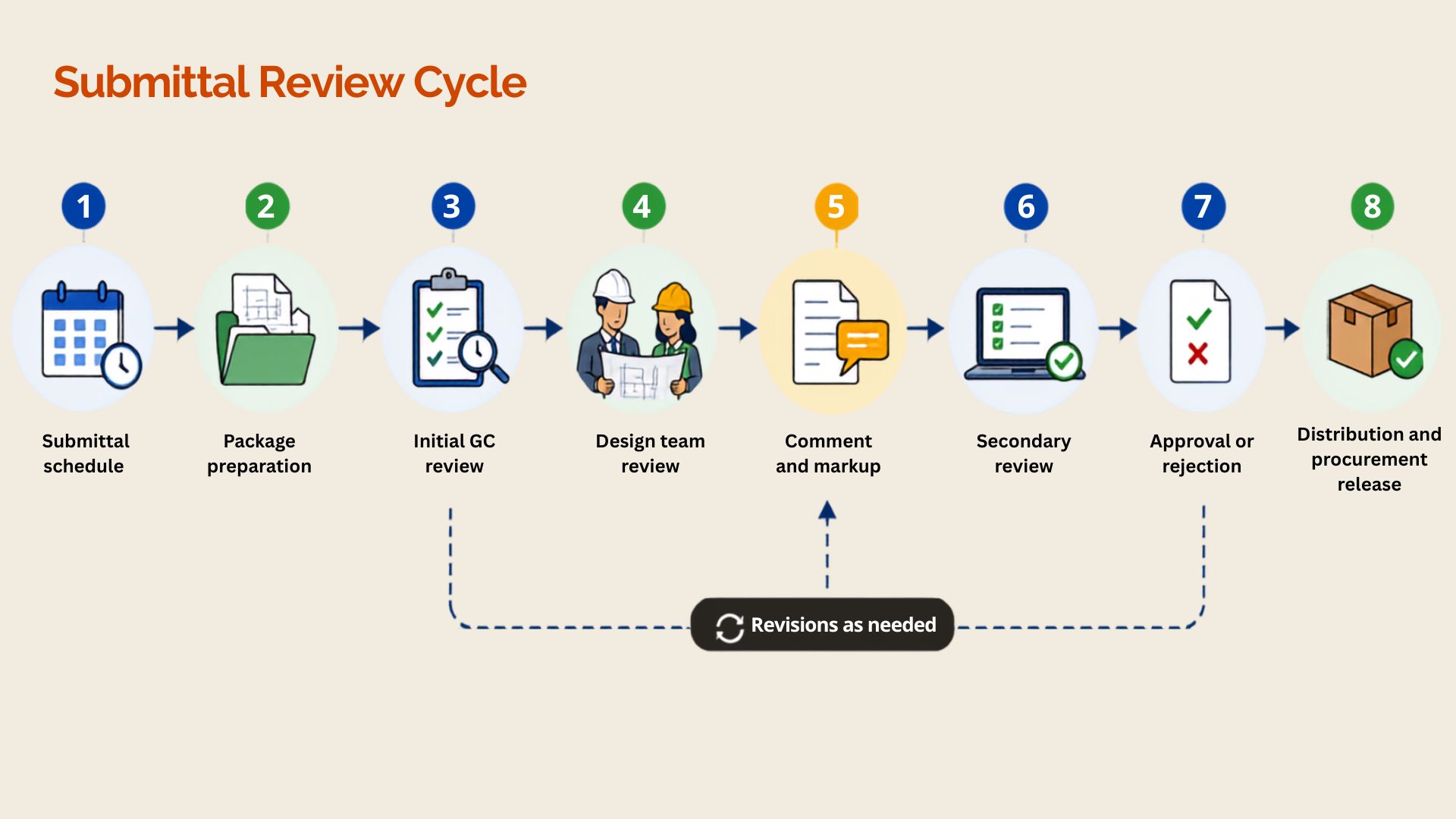
The submittal review process is lengthy and looks something like this:
Submittal schedule - The general contractor maps out what needs to be submitted, by whom, and by when, sequencing long lead time items ahead of items that can wait. Package preparation - The subcontractor or supplier pulls together the shop drawings, product data, samples, or engineering calculations required for their scope, checked against the spec section that governs them. Initial GC review - The general contractor reviews the package for conformance to the contract and catches obvious errors before it goes any further up the chain. Design team review - The architect or engineer, and sometimes a construction manager or owner's rep, checks the submittal against the specifications, applicable codes, and the original design intent. Comment and markup - Any discrepancy, from a wrong requirement reference to a dimension that doesn't match the contract documents, gets documented and sent back with specific comments. The contractor then updates the package to address every comment and sends it back into the queue. Secondary review - The reviewer checks that each comment was actually addressed, not just acknowledged, before moving toward approval. Approval or rejection - The submittal is approved, approved with noted corrections, or rejected outright, in which case it goes back to comment and markup for another round. Distribution and procurement release - Once approved, the submittal goes back down the chain so the contractor can order materials and proceed with the work. The approved submittal, along with every comment and revision along the way, gets logged for the project record and any future audit.
Each step depends on the one before it. That's why a bottleneck anywhere in the sequence, a reviewer buried in email, a comment lost in a shared drive, works its way forward into every step still to come.
How Submittal Delays Cost You
A spec calls for mineral wool insulation. The submittal lists mineral fiber instead, same material family, different name, and it's an easy miss for a reviewer working through the volume every real project generates. It's the kind of small mismatch that rarely stays contained to one line item.
A field engineer once shared a version of this on an industrial forum which shows how far one unverified number can travel.
On an early project involving precast drainage structures for a job with dual 60-inch bores, he needed the center-to-center measurement on the pipes in the receiving pit before releasing the precast for fabrication. Swamped with other work, he requested the figure from the boring subcontractor instead of measuring it himself. The number came back close enough to the plans that he released the precast on it.
When the structure arrived, the crew found the actual center-to-center measurement in the pit was three feet wider than what he'd been given. The precast wall had to be cut open, reinforced, and repoured to fit. By his own account, the rework cost roughly $20,000, a small fraction of the two-hundred-fifty-million-dollar project it was part of, but a direct result of one unverified number taken on trust instead of checked against the source.
A shop drawing review held up on a long lead time item, a transformer, a curtain wall system, a precast element, delays procurement, and that delay works its way through the schedule and into every trade sequenced behind it. What started as one overlooked requirement in a 40-page package can turn into a scheduling problem, a cost problem, and sometimes a dispute over who's responsible for the delay. Submittal review sits early in the sequence, so its failures rarely stay isolated.
AI Submittal Review Tools Already Exist. So Why the Hesitation?
Automated submittal review and AI construction document review tools have been available for a few years now, and plenty of firms have tested one. Adoption still lags what technology can do, and the hesitation is reasonable. Project managers who tried a submittal review tool and watched it miss a mismatched requirement, or return a confident answer with no way to trace it back to a source, grew more cautious as a result. In an industry where a missed detail becomes a change order, trust has to be earned line by line.
These aren't isolated incidents. Similar accounts keep surfacing wherever project managers trade notes on how AI tools are actually performing in the field. One contractor described a mid-sized GC that banned employees from using AI on company devices with automatic termination for any customer-facing AI use that hadn't been approved. The trigger, by his account, was someone relying on AI tools to move faster and sending a client a set of documents with errors serious enough to create real costs.
Another PM described using AI to scan submittals against the spec book and pull product data, useful for surfacing details a plain search would miss. But the spec sheets themselves, when built with AI or automated tools, were often full of errors: misspellings, wrong section references, requirements that didn't apply to the project's location. His conclusion was blunt: AI still needs a second set of eyes, which ultimately comes down to manual review.
Both accounts point to the same root issue. The tools people have tried were built to generate plausible output without showing their work. A submittal reviewer who can't trace an AI's answer back to a source has no way to catch it before a client, an inspector, or a jurisdiction does.
Building a Submittal Review Process That Holds Up to Scrutiny
Krixi Core’s Submittal Review is built on two distinct capabilities working together. Contextual Retrieval reads meaning rather than matching exact wording, so a spec section calling for mineral wool and a submittal listing mineral fiber gets flagged rather than waved through. Source-Verified AI means every finding traces back to its originating document, section, page, and requirement, so a PM isn't asked to take an output on faith.
That means a full review of a submittal package in minutes rather than days, with a summary that lays out what's compliant, what isn't, and where the judgment call belongs to the PM rather than the software. The review clears away the parts of the package that are straightforward, so a PM's attention lands on the two or three items that actually need a human decision, the ones a rushed manual pass is most likely to miss.
No tool can promise that nothing will ever slip past review. A full review with every finding traced back to its source is what actually holds up when a PM has to defend a decision six weeks later.
See what a traceable submittal review looks like on your own project's document set —